
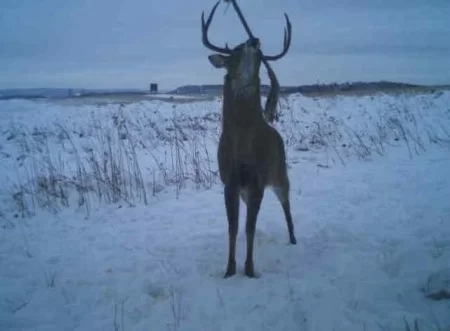
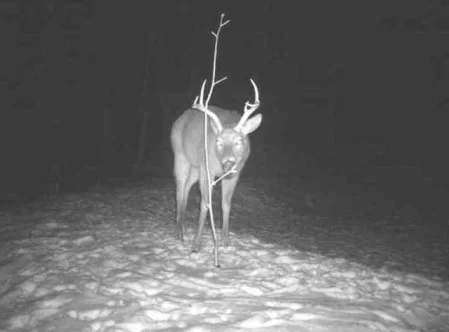
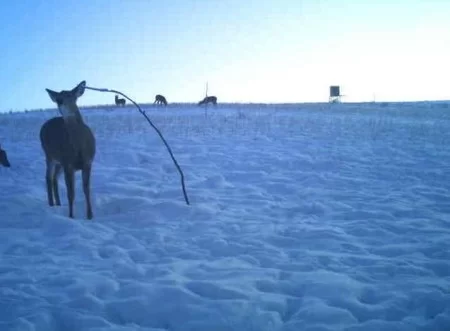
As things begin to slow down in the midwest with snow on the ground and temps below freezing, one thing has continued to heat up. With cell cameras using the last of their battery life, we are continuing to have pictures come in daily of deer still using HODAG setups.
With each product we sell we make analogies to describe what our products accomplish, one I like to use is a golf course. Every green is complete with a flag for us to aim at and keep us moving in the right direction. Some might go there straight away, and others might take a longer route there, even if not by our own volition. Regardless of skill everyone looks to the flag for where they should be aiming next, without it we would simply be swinging without direction.
Every HODAG setup is a like the flag on the golf course, a location for deer to aim towards as they make their way through food plots, and travel corridors. This is even more evident when looking at what were green plots turn into baron, snow covered stretches of nothingness. Some deer might head straight away to a setup and others might take a longer route (theirs not predicated on handicap). That is why our products make your trail cameras and scouting more effective. Rather than set your camera up and rely on luck to get deer to wander past it, each one of our products guide deer to a spot we choose to inventory, pattern, or hunt.
Observing the deer interaction on our products throughout the year, it is evident that with snow on the ground and hormone levels back to normal, there are even less distractions in the woods allowing them to focus on heading towards the "flag". That is the reason for the uptick in activity when things should be getting more stagnant. Whether it be a HempScent Rope on a field edge, a Licking Stick in a food plot, or a Licking Branch on a travel corridor, each leverage a deer's natural behavior to head towards a spot rather than wand aimlessly.
Food Is The Draw. The Licking Stick Is The Finisher.
A killer setup starts with food, but food alone won't put a deer on a spot. Here's why a HODAG Licking Stick earns a permanent place inside every food plot on your property — and how to get one working for the season ahead.
Everyone knows the value of a good food plot.
The food brings them to the area. It concentrates travel. It gives deer a reason to show up on your property day after day, night after night, year after year. Food is the draw — nobody's arguing that.
But if you've hunted a big open plot, you already know what "draw" doesn't guarantee: a shot. A buck can spend an hours in your plot and never get within 60 yards of your stand. He's fed. He's happy. He's totally out of range.
That's the gap a HODAG Licking Stick closes.
The food brings the deer to the plot. The Licking Stick puts them on a spot — a specific piece of ground, within bow range of your stand, where they stop, work the scrape, work the branch, and give you the picture or the shot you need.
That's what we mean when we say the Licking Stick is the finisher.
Why It Earns A Spot In Your Food Plot
Four reasons — every one of them earns its keep.
1. It gives the deer a spot to scent communicate.
We do everything we can to make our stands as good as possible. Good access. A well-designed food plot. Water on or near the plot. Cover behind and around. Every element stacks the odds a little more in our favor.
Adding a Licking Stick is one more element in that stack. It gives the deer already in the food plot a place to scent communicate — a communal hub where every mature buck in the area will eventually work in. Every doe in the area will check it too. Fawns will use it. Spikes will use it.
That's not just about seeing more deer. It's about giving the deer that are already in your plot a reason to be somewhere specific inside the plot — instead of drifting wherever the food happens to be greenest that week.
2. Visual curiosity.
Why do we love Licking Sticks in a food plot instead of tucked back in the timber?
Because in a food plot, they stand out like a sore thumb. A five-foot stick in a plot of brassicas, rye, or clover, is the lighthouse in the middle of an open sea. Every deer that steps into that plot sees it — from every angle, from every entry point, from the moment they clear the treeline.
Deer are far more visual than most hunters give them credit for. When something new appears in a plot they know, they investigate. That's what curiosity does. That's what a Licking Stick in a food plot triggers, every single time a new buck walks in.
Compare that to a stick set back in the woods, surrounded by a hundred other sticks that look the same. There's nothing to draw the eye. Nothing to trigger the investigation. Just another stick.
3. It draws them close for a shot.
Here's the piece hunters miss. The deer are already in your plot feeding — but that doesn't mean they're in bow range.
A Licking Stick gives you the ability to put them on a spot within that plot. You control where the stick goes. That means you control where the deer stops. That means you control the picture your trail cam gets, the shot angle from your stand, and the distance your bow needs to cover.
Put the stick 20 yards from your stand. That's where the buck stops. Put it 15. That's where he stops. Put it exactly on the wind side of an oak in the corner of your plot so the buck angles broadside — that's where he stops.
You're not hoping he wanders close. You're building the reason for him to come exactly where you want him.
4. It's all in the spring.
Every question we get about the Licking Stick's design eventually comes back to the spring.
The patented spring in every HODAG Licking Stick is what lets an aggressive buck work the stick as hard as he wants without breaking it. Traditional posts and rigid setups either snap off, get antlered out of the ground, or turn into a wrecking-ball problem after one hard rub. The spring absorbs the force. It flexes with the pressure and pops back into position when the buck walks away.
That's what keeps your stick standing. And a standing Licking Stick is a deer scent hub that stays active all year — through velvet, through pre-rut, through the rut, through post-rut, through the winter, right back into next August when the cycle starts over.
You set it once. It works from that day forward.
Where To Put It In The Plot
The right spot depends on the plot, but the principle is universal: put it where your shot lives.
For most setups, that means:
Bow range from your stand. Twenty to twenty-five yards is the sweet spot. Close enough for a clean shot, far enough for the deer to work the stick without picking you off in the tree.
Near water if you have it. A wildlife pond, a tub, a creek edge — deer already coming to water plus a Licking Stick 10-15 feet away is a compounding effect. He drinks, he scent-checks the stick, and both of those happen inside your shooting window.
In sight from multiple entry points. Deer come into food plots from different directions on different winds. A Licking Stick placed near the middle-forward part of the plot gets seen no matter which side they enter from.
What Happens After You Put One In
The days after installation are worth watching on your trail cam.
The first day or two, deer notice it. Some skirt it. Some walk right up and give it a curious sniff. By the end of the first week, does and fawns are working it casually — sniffing the branch, licking, leaving scent.
By week two, bucks in velvet start using it — often more than you'd expect for the summer months. Contrary to the old idea that scent communication only kicks on during the rut, deer talk to each other with scent all year long. Your stick catches every part of that conversation.
By early September, when the bucks start losing velvet and testosterone rises, the Licking Stick becomes a full-tilt communication hub. Every mature buck in the area works it on his own rounds, checks who else has been there, and leaves his own signature behind.
By October and November, when you're actually sitting the stand, that buck already knows the stick. He's been running it for months. He'll come to it out of habit — and he'll do it on your terms, on your spot, in your shot window.
That's inventory, pattern, and hunt in one setup.
Make Your Food Plots Better
The Licking Stick doesn't replace the food plot. It doesn't replace the water. It doesn't replace the stand.
It makes every one of them better.
The food gets them to the property. The water gives them a reason to stay. The stand puts you in position. The Licking Stick is the piece that puts them on the spot — the specific ground where you want them stopped, where your trail cam is dialed in, where your bow is already ranged.
Food is the draw. The Licking Stick is the finisher.
Shop The HODAG Licking Stick System
Licking Stick System — $44.99 · Made in the USAView The Licking Stick System →
Inventory. Pattern. Hunt.
HODAG Outdoors builds tactical scent and mock scrape systems for serious whitetail deer hunters. Every product is designed, engineered, sourced, and manufactured in the United States.
We’re proud to share that HODAG Outdoors was recently featured in Alberta Outdoors Magazine in an in-depth article discussing mock scrapes, deer behavior, and innovative tools for scent communication. The article highlights how serious whitetail hunters are using the HODAG HempScent Rope, Licking Stick System, Licking Branch System, and AllSeason Scent to create consistent deer interaction and increase success during the early season and pre-rut.
Being recognized by a respected Canadian hunting publication is an honor — and a testament to the effectiveness of our products designed by hunters, for hunters. This article, written by Kevin Wilson, is especially powerful as Kevin's experiences come from firsthand use of our HODAG Outdoors products, and his firsthand testimony of how he uses those products as an expeirenced deer hunter.
HODAG Outdoors featured in Alberta Outdoors Magazine
“I've tried some crazy things- some which actually worked, in turn revolutionizing the way I hunt. Two of the most significant involved making and hunting over mock scrapes, along with my newest introduction to the world of deer toys.”
Mock Scrapes Done Right
The article emphasizes something we’ve believed from the beginning:
“they will often take over the mock scrape, servicing it themselves.”
Mock scrapes are one of the most powerful tools a hunter can use — not just during peak rut, but throughout the season. When built properly and in a location the deer want to communicate in, they become year-round social hubs for deer. Our goal is to tee up the perfect scrape in locations that work for us as hunters, and then let the deer do the scenting for us. The AllSeason Scent simply stimulates the first couple deer to drop their own scent on it, and from there, it's like a dog pissing on a fire hydrant - once one does it the next can't help but do the same. The feature explains how establishing these scent communication hubs in spots that are ideal for you as a deer hunter can be a very valuable asset, and in Kevin's case, even revolutionize how you deer hunt.
Mature buck interacting with a HODAG Licking Branch mock scrape setup.
Why the HempScent Rope Works
One of the standout products discussed in the article is the HODAG HempScent Rope.
Our natural and non-chemically treated HempScent Rope fibers absorbs and disperses scent effectively while allowing deer to interact naturally — rubbing, chewing, and dropping their own glandular scent on the rope.
“Something about it draws deer in like moths to a flame.”
When jumpstarted with the included AllSeason Scent, the rope becomes a highly effective deer communication tool that works during early season, rut, and even late season conditions.
Hunters featured in the article observed consistent deer interaction, including younger bucks and mature bucks checking and working the setup repeatedly.
Big buck dropping his own glandular scent on the HempScent Rope.
The Licking Branch System: Perfect Mock Scrape Setup Anywhere
Another key product highlighted is the HODAG Licking Branch System.
Designed to simulate a natural overhanging branch, this system uses a spring-loaded mechanism that allows movement when deer interact with it. The result? A realistic response that holds up under aggressive buck activity and keeps your stick from breaking, which is one of the biggest gripes we hear from folks use competitors branch holders, which are rigid and more often than not lead to a broken branch, and innefective mock scrape. This lets hunters can establish a highly effective scent communication hub exactly where they want deer to stop — whether that’s in front of a trail camera or within bow range.
Licking Branch System installed creating the perfect overhanging mock scrape.
Deer Toys: Curiosity That Creates Opportunity
The feature also discusses the use of deer toys and interactive setups to increase engagement at stand sites.
Although we don't usually refer to our HODAG Outdoors products as "deer toys", when you watch how the deer actually use these scent hubs it kind of makes sense... especially when it's does and fawns. What they are actually doing is scent communicating and depositing their glandular scent on the setup... but to us it sure does look like they are having a grand old time playing with it!
This in turn gives us as hunters:
More and better trail camera footage
Super cool trail camera pictures and videos
More controlled shot opportunities
Longer engagement times in front of stand setups and trail cameras
An understanding of what deer are on the property and how they are using the property
Built by Hunters. Proven in the Field.
What makes this feature especially meaningful to us is that the article wasn’t written as a product pitch — it was written from Kevin's real-world hunting experience.
"I've seen a lot of gimmicks in the hunting industry, and I wasn't sure what to think about it. Pleasantly surprised by the results, after having one of them out for only a few hours, deer were magically visiting, and actually playing with them!" Our HODAG products are now an integral part of Kevin's deer hunting journey.
At HODAG Outdoors, we started out having our "marketing" be us sharing how we use these products in our own deer huntingstrategies, and sharing our results (mainly through trailcamera pictures and videos). Now, our focust has transferred to sharing our customers own experiences and stories. We’re honored that Alberta Outdoors recognized our products, and were willing to share with their Canadian audience of deer hunting enthusiasts.
HODAG customer and user posing with a big Canadian buck.
Read the Full Article
The full Alberta Outdoors Magazine feature dives deeper into mock scrape strategy, scent communication, and setup tips.
Read the Full Alberta Outdoors Article
Used with permission from Alberta Outdoors Magazine.
Explore the Featured Products
Ready to build a better mock scrape system?
HempScent Rope
Licking Stick System
AllSeason Scent
Licking Branch System
From Mock Scrapes to Active Scrapes: Building Better Deer Scent Hubs with HODAG's HempScent Rope (Field-Tested Lessons)
TL;DR: Scrapes work when they’re in the right place, deer scent mark them quickly, and you keep pressure low. Put the rope on a trail intersection deer already use, open the area so they feel comfortable approaching from any wind direction, and think of your HempScent Rope as a “deer telephone” for deer-to-deer scent communication—not bait or magic.
The Big Picture: Pattern Deer, Not Just a Buck
Hunters talk about “patterning a buck.” Useful—but zoom out. What wins over a season is understanding how all deer use your property as food, bedding, and hunting pressure changes. Early season focus should be on food; once soybeans yellow and acorns drop, activity shifts. Your scrapes should move with those pattern shifts, or have multiple locations and cameras set up to help you understand these shifts on the property you are hunting.
Key idea: Use cameras on multiple scent hubs or mock scrapes to map where deer are at different parts of the year on your property, and how you can take advantage of that information to hunt them.
Location Beats Everything
A HempScent Rope, or any type of mock scrape, in the wrong place will never “start working.” Generally, deer won't go out of there way to scent communicate and make scrapes or scent hubs. Location is by far the biggest factor in creating any successfull scrape, and the better you understand your property and how the deer use it, the better you will get at creating successfull setups.
Trail intersections & travel corridors (deer trails, logging roads, ATV trails, pinch points, etc...)
Between bedding and food in early/late season; between bedding areas during the rut.
Different Locations are better suited for different types of scent hubs. For example, a HODAG Licking Stick System is better suited, and often more effective, for a small food plot than a HempScent Rope would be.
If a deer doesn’t touch it within ~7–14 days, it's not in the right spot. Move it. Don’t wait a season!
Kickstart the Snowball (Fast Engagement Matters)
Scrapes function as communication hubs. One deer scent-marks, then another, and momentum builds.
Aim for first contact inside a week or two. One doe with fawns using it regularly can carry the site into October when bucks ramp up and use your rope to scent communicate.
If nobody touches it early, you’re likely off the main line, or just not in a spot the deer want to scent communcate in at that time of the year. Relocate, or understand your setup may not get used until the deer start using that location at a different time of the year.
When creating any mock scrape or scent hub, don't look at it like you are making a fake scrape. Instead, put yourself in the deer's perspective and try to create the perfect spot for the deer to communicate with one another naturally. Once the deer start dropping their own glandular scent, your setup is no longer a mock scrape, but rather an active scrape!
Human Pressure Explains a Lot
The “October lull” is often caused by September rush: hunters going in to their properties and stand locations getting in last minute work like hanging and trimming stands, hanging cameras, scouting, etc... put the deer on alert and can change their behaviors.
We like to try and get all our work done in the summer months, allowing you to minimize pressure leading up to and during the deer hunting season.
If you do go in and disturb your property, understand that it may take time to let the deer in that area get back to normal and be comfortable using the areas you intruded.
Setups That Get Touched
Make approach easy and safe from every wind, using a weed whacker to clear a large area around your HempScent Rope. When deer feel comfortable accessing your mock scrape setup, they are more likely to use it.
Height: hang at deer nose level; too high or too low kills interaction. We like to have the end of our rope be 3.5-4 feet from the ground. Use paracord to hit the perfect height off otherwise “wrong” limbs.
Clear a bubble: weed-whack ~6 feet around the rope and trim surrounding brush so mature deer can circle downwind and still feel comfortable.
Knot tip: many hunters see more interaction with a simple overhand knot near the rope’s working end—adds surface and a hard spot for deer to rub and deposit their glands on.
Inventory vs. Hunting Setups: Use Rope Scrapes Intentionally
Inventory/Intel: Hang on high-use trails, close to bedding, and other locations on your property to learn which part of the property specific bucks and other deer are using during particular times of the year.
Kill Sites: For areas that you want to hunt, adding a HempScent Rope setup can help you to stop a deer for a shot, as well as get an understanding or pattern on when a specific deer is using that trail or location. Hunt that location based on wind and the intel your trail camera gives you!
Fine-tuning: Small differences in location can make big differences. Year to year, small movements of the rope, as small as 10–50 yards at a time, can help you dial in where the best location for your rope, camera, and stand are in that particular section of your property.
Baited States: Separate the Hub from the Pile
When customers are struggling to get deer to use their setups its often because it is located right next to or near a bait or mineral site. I believe it is due to the deers mind and attention focused on feeding, and not on scent communication. Move locations with it, such as trail crossings, logging roads, food plots, natural openings in the woods... etc. You want to put these things in areas that deer are naturally going to already, this just puts them on a spot.
We have found from hunting southern states like Oklahoma where baiting is an integral part of the deer hunting strategy that creating scent hubs on the travel path from bedding to the bait can be an effective way to pattern and hunt a buck that is using the bait, but not getting their until after dark.
Place your rope 50–75 yards off the pile on the approach trail from bedding.
You’ll pull earlier daylight interaction and a more natural, relaxed behavior at the rope.
Why a Rope “Doesn’t Work” (and Fixes)
Wrong place. Move to a defined trail or intersection.
Hidden in brush/grass. Hang where it stands out; clear the ground and surrounding area.
Too close to a trunk. Give deer room to work—avoid hanging your rope close to the trunk of a tree (at least 5 or 6 feet minimum).
Bad height. Adjust with paracord; aim for nose-level or 3.5-4 feet from the ground.
Expecting bait behavior. Ropes amplify natural communication—they don’t manufacture traffic or draw deer from long distances like bait does.
Scent: The Honest, Effective Approach
Bottled scents don’t beat a real deer’s glands touching your rope, mock scrape, or any type of deer communication scent hub. This is why we created the HODAG AllSeason Scent, and include it with all of our systems. The scent is merely designed to get deer to initially interact with your setup. Once that happens, let the natural deer scent communication behavior take over!
Apply a starter at the initial setup.
Once deer interact, stop reapplying. Save the bottle for your next setup.
Don’t obsess over gloves and suits—focus on where you hang it and how deer approach.
Learn more about everything deer scent hubs and mock scrapes on our website!